
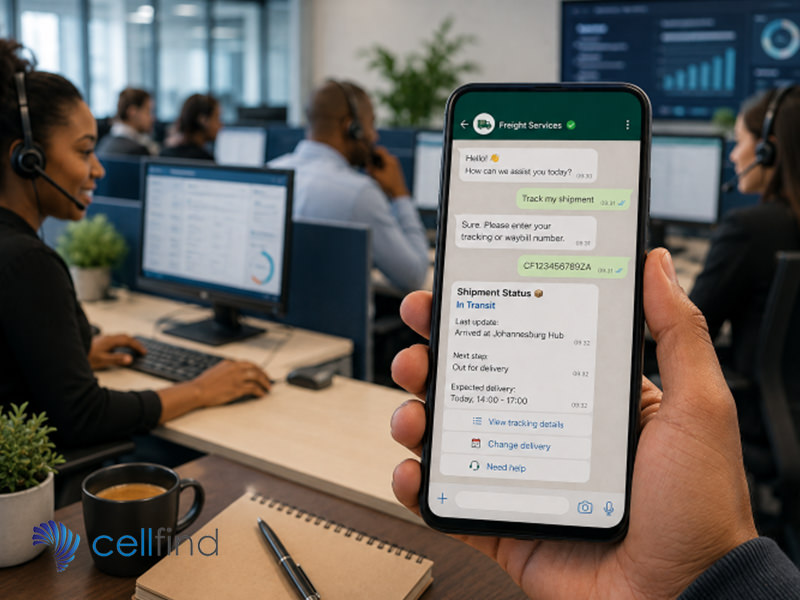
How an established Southern African freight company created a more connected customer experience using a WhatsApp Business number and API connectivity provided by Cellfind
THE SOLUTION: A connected WhatsApp communication channel supporting shipment notifications, customer self-service, delivery changes, live agent assistance and operational coordination.
Executive Summary
A long-established Southern African express freight provider wanted to improve communication between its customers, service teams and delivery operations.
Customers needed convenient access to shipment updates, tracking information and delivery support. At the same time, the company wanted to reduce repetitive enquiries and give customers a simpler way to respond when deliveries required attention.
WhatsApp provided a familiar channel through which customers could receive shipment notifications, request tracking information and respond to delivery requirements.
Cellfind provided the WhatsApp Business number and API connectivity that established the messaging foundation. This enabled the courier’s authorised systems to communicate with customers through WhatsApp and connect customer responses with service and operational processes.
The resulting service brought shipment notifications, conversational tracking, delivery changes, customer support, proof of delivery and post-delivery communication into a more connected customer journey.
Background and Context
Customer communication is an important part of the courier and express freight experience.
Once a shipment has been collected, customers want clear information about its progress. They want to know when the consignment is in transit, when delivery is expected, and what to do if circumstances change.
Traditional communication methods can make these simple questions harder to answer. A customer may need to visit a tracking website, enter a reference number, contact a branch or wait for assistance from a service agent.
The same problem creates pressure for courier operations. Service teams spend time answering repetitive tracking enquiries, while dispatchers and drivers may need to resolve incomplete addresses, unavailable recipients, and changing delivery instructions.
The freight provider needed a communication channel that made shipment information easier to access while connecting customers with the operational teams responsible for completing the delivery.
WhatsApp offered a way to bring those interactions into a familiar mobile channel without replacing the courier’s existing tracking and operational systems.
Problem Statement
The solution needed to address several connected customer service and operational requirements:
- Shipment visibility: Customers needed timely information about the progress of their consignments.
- Tracking accessibility: Shipment information needed to be available through a familiar channel without requiring customers to navigate a separate portal for every enquiry.
- Delivery exceptions: Customers needed a simple way to respond when an address required confirmation, a recipient was unavailable or the delivery date needed to change.
- Customer self-service: Routine enquiries needed to be handled without requiring assistance from a call centre or branch employee.
- Human assistance: Complex, delayed, damaged or disputed shipments still required access to authorised service agents.
- Operational coordination: Customer responses and delivery instructions needed to reach dispatch teams and other operational systems.
- Security and privacy: Personal information, addresses and delivery documentation required appropriate access controls and data handling.
Methodology and Approach
The implementation was approached as a connected customer communication service rather than a standalone chatbot.
Cellfind provided the WhatsApp Business number and API connectivity required to establish communication through the WhatsApp Business Platform. The API created the foundation through which authorised systems could send messages, receive customer responses and connect conversations with operational processes.
The implementation focused on seven connected areas:
- Establishing the WhatsApp Business channel
- Providing proactive shipment notifications
- Making tracking information conversational
- Managing delivery changes and exceptions
- Combining self-service with live agent support
- Connecting customer communication with operations
- Supporting proof of delivery and feedback
This approach ensured that WhatsApp formed part of the wider delivery process rather than becoming another isolated contact number.
Implementation
1. WhatsApp Business Number and API Connectivity
Cellfind provided the WhatsApp Business number and API connectivity required to establish the messaging channel.
This created the infrastructure through which authorised systems could send shipment notifications and receive customer responses.
The business number gave customers a consistent channel for courier-related communication, while the API enabled the channel to connect with automated journeys, service agents and operational systems.
Cellfind’s role focused on providing the messaging foundation. The courier remained responsible for its freight operations, customer information, tracking systems and delivery processes.
2. Proactive Shipment Notifications
Customers could receive WhatsApp notifications as their consignments moved through the delivery journey.
Typical shipment stages included:
- Collection booked
- Shipment collected
- Received at a distribution hub
- In transit
- Out for delivery
- Delivered
- Delivery exception requiring attention
Proactive communication gave customers visibility without requiring them to contact a branch or service agent for every update.
Where appropriate, a notification could also provide a next action, such as confirming availability or requesting assistance.
This changes the role of the communication channel. Instead of waiting for a customer to ask where a shipment is, the courier can provide relevant information as the shipment progresses.
3. Conversational Shipment Tracking
The WhatsApp journey provided customers with a simple way to request shipment information.
A customer could enter a tracking or waybill number and ask for the current position of the consignment.
The chatbot could retrieve the latest available information and provide:
- Current shipment status
- Most recent tracking event
- Expected next step
- Available delivery information
- Relevant branch details
- A link to more detailed tracking
WhatsApp did not replace the courier’s existing tracking environment. It provided a conversational route into the information already held within the courier’s systems.
That distinction matters. The value of the channel comes from making existing information easier for customers to access, rather than creating a separate tracking process.
4. Delivery Rescheduling and Address Confirmation
Delivery exceptions create additional work for customers, drivers, dispatchers and service teams.
Common causes include:
- Incomplete delivery addresses
- Incorrect contact information
- Restricted access to a delivery location
- An unavailable recipient
- A requested change to the delivery date
- Additional directions being required
The WhatsApp journey allowed customers to respond to these situations through structured options.
Depending on the delivery requirement, customers could confirm an address, provide additional directions, request another delivery date, nominate an alternative recipient or ask to collect the consignment from a branch.
The updated information could then be passed to the appropriate operational team.
This creates a structured record of the customer’s instruction rather than leaving an important delivery change inside an informal phone conversation.
5. Customer Self-Service and Live Agent Support
The chatbot handled routine enquiries that did not require human investigation.
Self-service functions included:
- Shipment tracking
- Delivery status
- Collection information
- Branch contact details
- Operating hours
- Proof of delivery requests
- Address confirmation
- Delivery instruction updates
- Frequently asked questions
When the chatbot could not resolve an enquiry, the customer could be transferred to an authorised service agent.
The agent could receive the relevant conversation history, shipment reference and reason for escalation. This gave the agent the context needed to continue the interaction without requiring the customer to repeat the same information.
Automation therefore handles the predictable parts of the journey while human support remains available for delayed, damaged, missing or disputed consignments.
6. Operational and Dispatch Coordination
Customer instructions only create value when they reach the people responsible for acting on them.
The WhatsApp API made it possible for customer responses to connect with the systems and dashboards used by service and dispatch teams.
Operational information could include:
- Address confirmations
- Delivery date changes
- Additional directions
- Recipient availability
- Branch collection requests
- Unresolved delivery exceptions
- Live agent escalations
This creates a clearer record of customer instructions and reduces reliance on fragmented telephone calls or informal communication between customers, drivers and service teams.
The customer sees a WhatsApp conversation. Behind that conversation sits the operational workflow required to act on what the customer has said.
7. Proof of Delivery and Customer Feedback
The communication journey continued after delivery.
Once a consignment was delivered, the customer could receive a confirmation message through WhatsApp. Depending on the courier’s operational process, this could provide secure access to:
- Delivery date and time
- Consignment reference
- Recipient confirmation
- Digital proof of delivery
- Delivery documentation
The same journey could invite the customer to provide brief feedback about the delivery experience.
Negative feedback could be routed to a service recovery team, while positive feedback could help the company identify successful delivery practices.
This extends WhatsApp beyond shipment notifications and tracking into the post-delivery part of the customer relationship.
Results and Outcomes
The WhatsApp implementation created a more connected communication journey for customers and operational teams.
Improved Shipment Visibility
- Customers could receive updates as consignments progressed.
- Shipment information became easier to access.
- Customers could request tracking information through a familiar channel.
- Proactive messages reduced uncertainty around delivery progress.
More Convenient Customer Self-Service
- Routine tracking enquiries could be completed without calling a branch.
- Customers could access delivery information outside traditional service channels.
- Structured prompts made common enquiries easier to complete.
- Customers retained access to live assistance when required.
Better Management of Delivery Exceptions
- Customers could confirm addresses and provide additional directions.
- Delivery changes could be captured through a structured process.
- Operational teams received clearer customer instructions.
- Delivery issues could be identified and addressed earlier.
More Connected Operations
- WhatsApp communication could be linked with tracking and service workflows.
- Dispatch teams gained greater visibility into customer responses.
- Conversation history created a clearer record of the interaction.
- Service agents could receive the context required to resolve escalated enquiries.
Consistent Customer Communication
- Customers interacted with a recognised business number.
- Shipment notifications followed a consistent format.
- The same channel supported automated messages and human assistance.
- Post-delivery communication formed part of the broader customer journey.
Analysis and Lessons Learned
Proactive Communication Reduces Uncertainty
Customers should not need to contact a courier for every shipment update.
Timely notifications set expectations and give customers an opportunity to respond before a delivery problem becomes a failed delivery or another service enquiry.
Integration Creates the Real Value
The WhatsApp number is the customer-facing entry point. Its usefulness depends on the tracking systems, APIs, service teams and operational workflows supporting it.
A messaging channel that cannot access current shipment information or pass customer instructions to operations has limited value.
Automation and Human Support Must Work Together
Tracking and routine branch enquiries can be automated.
Delayed, missing, damaged or disputed consignments often require investigation and judgement. A successful customer journey therefore needs a straightforward path from self-service to an authorised service agent.
Customer Instructions Must Reach Operations
An address change or delivery instruction cannot remain inside a chatbot.
The information needs to reach the teams responsible for completing the delivery. Connecting WhatsApp responses with operational workflows is what turns a conversation into an actionable service interaction.
Security Must Be Built Into the Journey
Courier communication can contain personal information, addresses and delivery documentation.
Access controls, appropriate verification and responsible data handling therefore need to form part of the solution rather than being added after the communication journey has been designed.
Performance Must Be Measured
The success of the channel should be evaluated using both operational and customer experience measures.
Relevant measures include:
- Shipment notification delivery
- Self-service resolution
- Live-agent escalation
- Delivery exception resolution
- Address confirmation
- First-attempt delivery success
- Proof-of-delivery access
- Customer satisfaction
- Message failures and opt-outs
Specific performance claims should only be published where the courier has a reliable baseline and verified results.
Conclusion
The implementation demonstrates how WhatsApp can become part of a broader courier service ecosystem rather than simply another channel for sending delivery messages.
Customers can receive updates, track consignments, respond to delivery exceptions, provide instructions, access proof of delivery and request assistance through one familiar channel.
The value comes from connecting that channel to the systems and people responsible for completing the delivery.
By combining proactive communication, customer self-service, live-agent support and operational integration, courier companies can create a more connected delivery experience while giving service and dispatch teams clearer access to customer interactions.
The greatest value does not come from sending another delivery notification. It comes from connecting customer communication with tracking systems, service agents and courier operations.
Cellfind as the Solution Provider
Cellfind is a South African mobile technology solutions provider specialising in communication platforms that connect organisations with their customers.
For this implementation, Cellfind provided the WhatsApp Business number and API connectivity required to establish the messaging foundation.
The API enabled authorised systems to send shipment notifications, receive customer responses and connect WhatsApp conversations with customer service and operational processes.
Through its expertise in WhatsApp Business, SMS, USSD, live chat, API connectivity and managed messaging services, Cellfind helps organisations create secure and scalable customer communication journeys.
READY TO START? Turn WhatsApp into a connected customer service channel for your courier or logistics business. Contact Cellfind to explore a WhatsApp solution designed around your customer communication and operational requirements.