
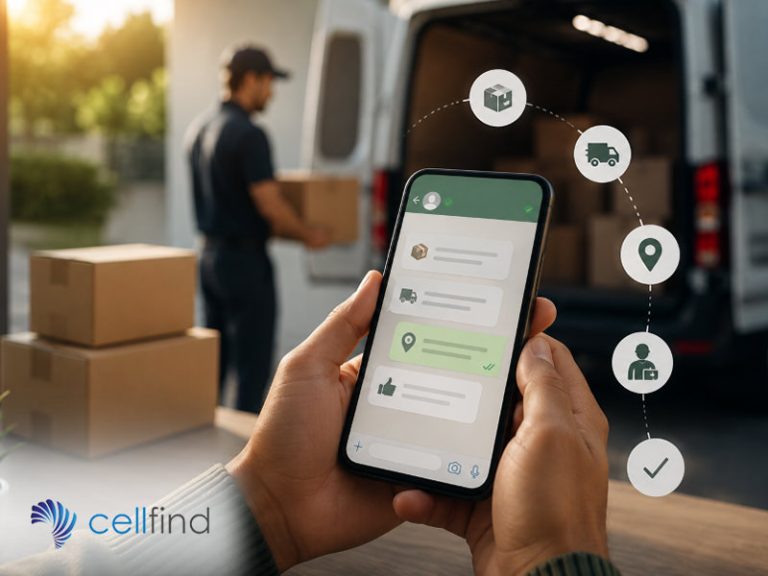
Once a shipment leaves a depot, the customer’s questions are usually straightforward.
Where is it? When will it arrive? Can I change the delivery date? Did someone receive it? What happens if the address is wrong?
The answers may be sitting across several systems and teams. The customer may still have to find a tracking page, enter a waybill number, call a branch or wait for an agent.
For an established Southern African express freight provider, the challenge was to make those interactions easier without creating another disconnected customer service channel.
WhatsApp provided the front door. Cellfind provided the WhatsApp Business number and API connectivity that connected it to the courier’s existing systems and operational processes.
Key points
- Customers want shipment information without having to chase it through different channels.
- WhatsApp can turn tracking from a website lookup into a conversational service.
- Delivery exceptions can be handled through structured responses rather than fragmented calls and messages.
- Automation handles routine enquiries, while live agents remain available for shipments that need investigation.
- The value sits behind the WhatsApp number. Tracking systems, service teams and operational workflows have to connect to it.
Why do courier customers keep asking where their shipment is?
Because shipment visibility is part of the delivery experience, not an optional extra.
Once a consignment has been collected, customers want to know what is happening to it. They want confirmation that it has moved, that it has reached a distribution hub and that it is on its way to them.
Traditional tracking puts the responsibility on the customer. Find the tracking page. Enter the reference. Read the latest event. Contact someone if the information does not answer the question.
That creates unnecessary work on both sides.
Service teams receive repetitive tracking enquiries while customers wait for information that already exists somewhere in the courier’s systems.
A better approach is to make the information available where the customer is already communicating.
That is the role WhatsApp plays in this case. It provides a familiar route into the courier’s existing shipment information rather than asking the customer to navigate another service environment.
Why is WhatsApp suited to shipment tracking?
WhatsApp turns a tracking lookup into a conversation.
A customer can enter a tracking or waybill number and request the latest shipment information. The journey can return the current status, most recent tracking event, expected next step, available delivery information, relevant branch details, and a link to more detailed tracking.
The important point is that WhatsApp does not replace the courier’s existing tracking system.
It provides another way to access it.
That’s an important note. A chatbot that simply repeats generic delivery information adds another layer. A WhatsApp journey connected to current shipment data gives the customer a useful answer.
The same channel can also move the interaction forward. If the shipment requires a response, the customer can be given an appropriate next action rather than being left with a status message and another phone number to call.
What happens when a delivery does not go to plan?
This is where delivery communication becomes more than tracking.
A shipment can be delayed because an address is incomplete. The recipient may be unavailable. A location may have restricted access. The customer may need to provide additional directions or request another delivery date.
Each exception creates work for several people: the customer, service teams, dispatchers, and potentially the driver.
The WhatsApp journey gives the customer structured options for responding.
They can confirm an address, provide additional directions, request another delivery date, nominate an alternative recipient or ask to collect the consignment from a branch.
The updated information can then be passed to the appropriate operational team.
The benefit is not simply that the customer can type a message. It is that the message is captured as part of a defined process and can reach the people responsible for acting on it.
Does WhatsApp replace the courier’s tracking system?
No. It just makes the existing information easier to reach.
This is an important distinction when designing a WhatsApp service for logistics.
The courier still needs its tracking environment, freight processes and operational systems. WhatsApp becomes the customer-facing communication layer that connects into those systems.
That means customers can receive shipment notifications as a consignment moves through stages such as collection, distribution hub arrival, transit and out-for-delivery.
It also means customer responses can move back into the operational process.
The WhatsApp number is therefore only the visible part of the solution. The API connectivity behind it is what allows authorised systems to send messages, receive responses and connect conversations with customer service and operations.
Where do live agents fit?
Live agents fit where the problem stops being routine.
Shipment tracking, branch information, operating hours and common delivery questions are suitable for self-service.
A delayed, missing, damaged or disputed consignment may require investigation.
The WhatsApp journey allows customers to move from automated assistance to an authorised service agent when necessary. The agent can receive the relevant conversation history, shipment reference and reason for escalation.
That means the customer does not necessarily have to start the story again.
The principle is simple: automate the predictable work and keep a person available for the situations that need judgement or investigation.
What has to exist behind the WhatsApp channel?
The WhatsApp channel is the smallest part of the service.
For it to work properly, it needs to connect to the systems and people responsible for the delivery.
That includes:
- Shipment and tracking information that can provide current status.
- Automated notification processes that trigger messages as consignments move.
- Customer service workflows that receive questions and escalations.
- Operational systems and dashboards that receive customer instructions.
- Dispatch teams that can act on address confirmations and delivery changes.
- Processes for handling proof of delivery and post-delivery communication.
A customer may see a short WhatsApp conversation. Behind it sits a much larger operational process.
That is what separates a messaging channel from a connected customer service platform.
What can customers do after delivery?
The customer journey does not have to end when the parcel arrives.
Depending on the courier’s operational process, the WhatsApp journey can provide access to delivery date and time, consignment reference, recipient confirmation, digital proof of delivery and delivery documentation.
It can also provide an opportunity for feedback.
This creates a single communication thread that follows the shipment through more of its lifecycle: before delivery, during delivery, when an exception occurs, and after the consignment has been completed.
For the courier, that creates another opportunity to capture useful customer information and route negative feedback to the appropriate service team.
What should courier companies measure?
Sending more messages is not the same as improving communication.
The useful measures are the ones that show whether customers are getting answers and whether those answers are helping operations.
Relevant measures include:
- Shipment notification delivery.
- Self-service resolution.
- Live-agent escalation.
- Delivery exception resolution.
- Address confirmation.
- First-attempt delivery success.
- Proof-of-delivery access.
- Customer satisfaction.
- Message failures and opt-outs.
The important point is to establish a reliable baseline before publishing specific performance claims.
A WhatsApp channel should be measured as part of the wider delivery operation, not simply by message volume.
What about security and customer information?
Courier communication can contain personal information, delivery addresses and documentation.
That means security and privacy need to be built into the journey.
Access controls, appropriate verification and responsible data handling should be considered when the WhatsApp channel is connected to tracking information and delivery records.
The customer should be able to access the information relevant to their shipment without turning the WhatsApp conversation into an uncontrolled repository of customer data.
The same principle applies to proof of delivery and other documents made available through the channel.
Where to start
Courier communication makes a strong WhatsApp use case because the customer journey is already structured around identifiable events.
A shipment is booked. It is collected. It moves through the network. It goes out for delivery. It is delivered, or an exception needs attention.
Start by mapping those events and the customer questions attached to each one.
Then work backwards into the systems that hold the information and the teams that need to act on customer responses.
The WhatsApp channel is the straightforward part.
The real work is connecting shipment information, customer conversations and operational processes so that a customer message can become a useful action.
In this case, Cellfind provided the WhatsApp Business number and API connectivity that established that communication layer, allowing authorised systems to send shipment notifications, receive customer responses and connect WhatsApp conversations with customer service and operational processes.
The lesson is straightforward: the greatest value does not come from sending another delivery message. It comes from connecting customer communication with tracking systems, service agents and courier operations.